By Viktor Yoshimura – 14th October 2026
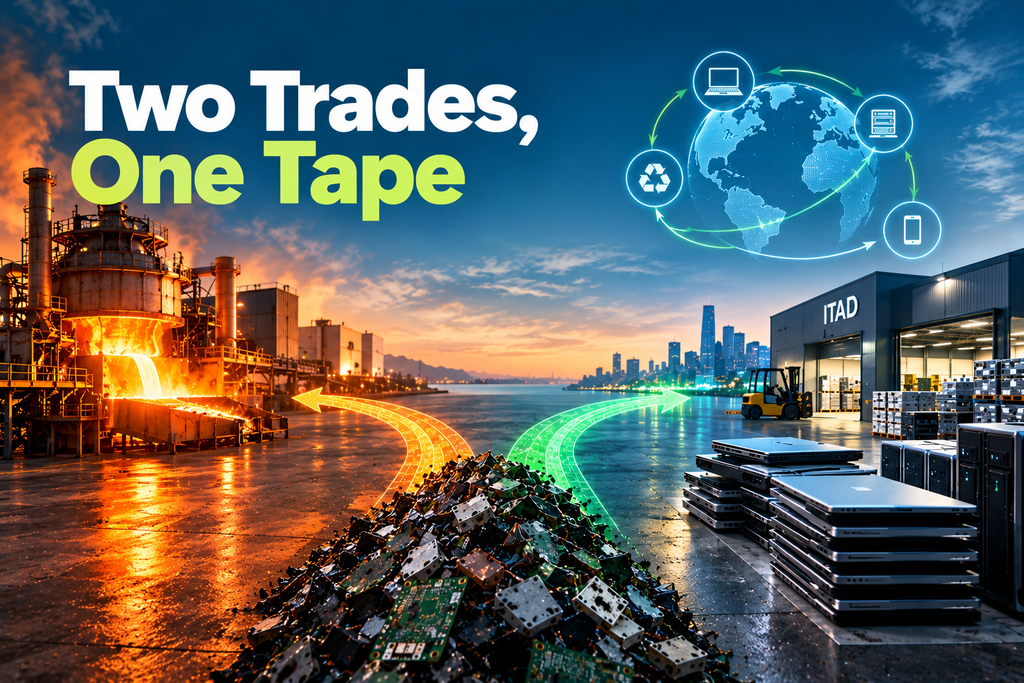
Asian buyers in North American e-scrap are usually read as one strategy. There are two, and they’re bidding for the same hardware.
Over the past five years, Japanese and Korean industrial groups have taken ownership positions in North American e-scrap and ITAD businesses. Read together, the deals are usually explained as refiners securing feedstock. That’s right for half the list. The other half is buying something else, and the two halves are competing for the same hardware.
The concern usually sitting behind these deals is ownership of the collection layer: whoever owns collection ends up controlling the recovered materials. That’s a fair question, but the split inside the deal list changes what that ownership actually buys.
The squeeze behind it
The pressure starts in smelting, not ITAD. Copper treatment and refining charges, the fee a smelter earns for turning concentrate into metal, have collapsed. The 2026 annual benchmark settled at zero dollars a tonne, and spot terms were reported at around minus $127 per dry tonne by the end of June. Smelting capacity was built for mine supply growth that didn’t arrive.
One facility shows the result. Mitsubishi Materials will stop copper smelting and refining at Onahama by the end of March 2027, taking a ¥21 billion impairment, but it is keeping the electrolytic and precious metals plants and moving the site toward electronic and copper scrap. Japan can’t generate enough scrap to fill that. The furnaces are in Asia and much of the material is in North America, so reaching back into collection is the obvious move.
Trade A buys the material, Trade B buys the asset
Korea Zinc is the clearest Trade A case, and it started earliest. It bought 73% of Igneo Technologies in July 2022 for US$332 million and the rest in January 2023. Igneo is collection and shredding infrastructure rather than an ITAD: around 140,000 tonnes a year of US capacity operating or under construction, a 30,000 tonne furnace in northern France and another planned in Savannah, Georgia. In April 2024 its US holding company, PedalPoint, added the scrap trader Kataman Metals. Korea Zinc is now proposing a smelter in Tennessee, publicly costed at around $7.4 billion, although a shareholder dispute over the project leaves its timing unsettled.
Collect, shred, trade, smelt, refine: nobody else on the list owns all five steps. It also links back to a recent piece here on drive magnets. PedalPoint Recycling was one of the partners in the Western Digital and Microsoft pilot that recovered rare earths from shredded drives, so that pilot ran through one of the Trade A buyers.
Mitsubishi Materials runs the same logic with a shorter chain. It announced a minority stake in Elemental USA, a US e-waste and ITAD business, in December 2025 and completed it in January 2026, weeks before confirming the Onahama change. Neither company bought a resale book, so nothing pulls their material away from the furnace.
Trade B looks different on the public record. SK ecoplant bought TES outright for roughly $1 billion in February 2022. In 2025 it sold its waste and water treatment business to KKR for around $1.2 billion to concentrate on IT lifecycle management through SK tes and memory distribution through Essencore. Given the choice between metals and IT services, it kept IT services. Sumitomo Corporation’s July 2026 investment in GreenTek Solutions, a Texas ITAD, sits in its leasing business, and the announcement talks about collection, data erasure, resale and AI-driven data centre growth without mentioning metal recovery. Sojitz took a minority stake in TES-AMM Japan in 2021 and launched Hi-Kii, an ITAD quoting platform, in 2025. The one deliberate bridge is Sojitz and JX Metals investing together in Canada’s eCycle Solutions in 2023: a trading house paired with a smelter.
| Trade A: metals-led | Trade B: services-led | Why it matters | |
| Who | Korea Zinc; Mitsubishi Materials | SK ecoplant; Sumitomo; Sojitz | Different buyer type, different balance-sheet logic |
| What they bought | Shredding, processing and trading capacity | ITAD services, resale and lifecycle platforms | Material handling versus client relationships |
| Revenue driver | Recovered metal value | Service fees plus resale margin | Resale margin is higher and arrives sooner |
| Where the asset ends | Shredded, smelted, refined | Redeployed into a secondary market | Only Trade A ends in metal |
| Time horizon | Decades, matched to smelter life | 3 to 7 years, matched to refresh cycles | They aren’t waiting for the same thing |
Table 1. Basis: company announcements, 2021 to 2026 (sources below). Time horizons are the author’s analysis.
Why the two compete
If these were two routes to the same place, the split would be academic. They want the same physical asset. Per unit, on the units that matter, resale outbids metal by a wide margin: a recent-generation accelerator or a current-spec server is worth far more working than shredded. Any owner of an origination business sends that hardware to resale, and metal recovery gets the residue and the units that fail test.
So as data centre reuse markets mature, which is what the Trade B buyers are paying to speed up, metal-bearing material reaches the furnace thinner and later. On a typical enterprise redeployment cycle I’d put that at three to five years before the board reaches a refiner, and by then it comes through the merchant market rather than off the decommissioning floor. I haven’t seen anyone connect the two halves of the deal list this way.
One group is buying material. The other is buying the asset before it becomes material.
That also changes the ownership question. A resale-weighted ITAD mostly outputs working hardware, so owning one gives little control over a minerals flow. The concern applies cleanly to Trade A and only weakly to Trade B, and the transactions shouldn’t be counted together for that purpose.
What it means for Asia-Pacific
The same split will reach this region. In the pipeline piece I derived about 10.5 GW of live data centre capacity across Asia-Pacific. That installed base, in Tokyo, Singapore, Johor and Bangkok, is the hardware that decommissions first, and nobody has consolidated the origination layer in Southeast Asia yet. In Japan, Itochu has already assembled a lifecycle stack, coming at it from the reuse end.
Two things follow. Secured access to hardware is the scarce asset, while processing capacity is earning negative margins. And what a buyer underwrites is auditability rather than tonnage: certification with the right scope, documented chain of custody, verifiable sanitisation, direct client relationships rather than brokered volume, and clean cross-border paperwork. To a Japanese buyer, a business with volume and weak records is uninvestable at any price, because the exposure is reputational.
When consolidation comes here, both trades will arrive, and the business being bought will be pulled toward one of them.
If you run an ITAD in the region: which trade would a buyer be buying you into, and what would that do to your resale book?
The two-trades framing and the three to five year delay are the author’s analysis; the delay is derived from typical enterprise redeployment cycles and is directional. Transactions and figures are sourced below.
Sources
Korea Zinc: 73% of Igneo Technologies for US$332m, July 2022; remainder January 2023; Igneo capacity figures. Recycling International; Recycling Today.
PedalPoint Holdings (Korea Zinc): acquisition of Kataman Metals, Business Wire, 4 April 2024.
Korea Zinc: proposed Tennessee smelter, about $7.4bn, and shareholder dispute, August 2026. Recycling Today; Seoul Economic Daily; KED Global.
Mitsubishi Materials: shares in Elemental USA E-Waste & ITAD, announced 18 December 2025, completed 30 January 2026 (company releases).
Mitsubishi Materials: end of copper smelting and refining at Onahama by March 2027, ¥21bn impairment. Reuters; Mining.com.
2026 copper TC/RC benchmark at $0/t; spot about minus $127/dmt by end-June 2026. Mining.com; Benchmark Mineral Intelligence; S&P Global.
SK ecoplant: acquisition of TES for about US$1bn, February 2022; sale of waste and water units to KKR for about $1.2bn, 2025. GlobeNewswire; KED Global.
Sumitomo Corporation: investment in GreenTek Solutions, July 2026 (company release).
Sojitz: minority stake in TES-AMM Japan, January 2021; Hi-Kii platform, May 2025 (company releases).
JX Metals and Sojitz: investment in eCycle Solutions, February 2023 (company releases).
Western Digital, Microsoft, Critical Materials Recycling and PedalPoint Recycling, Advanced Recovery and Rare Earth Capture at Scale, June 2025.