
By Viktor Yoshimura – 14th October 2026
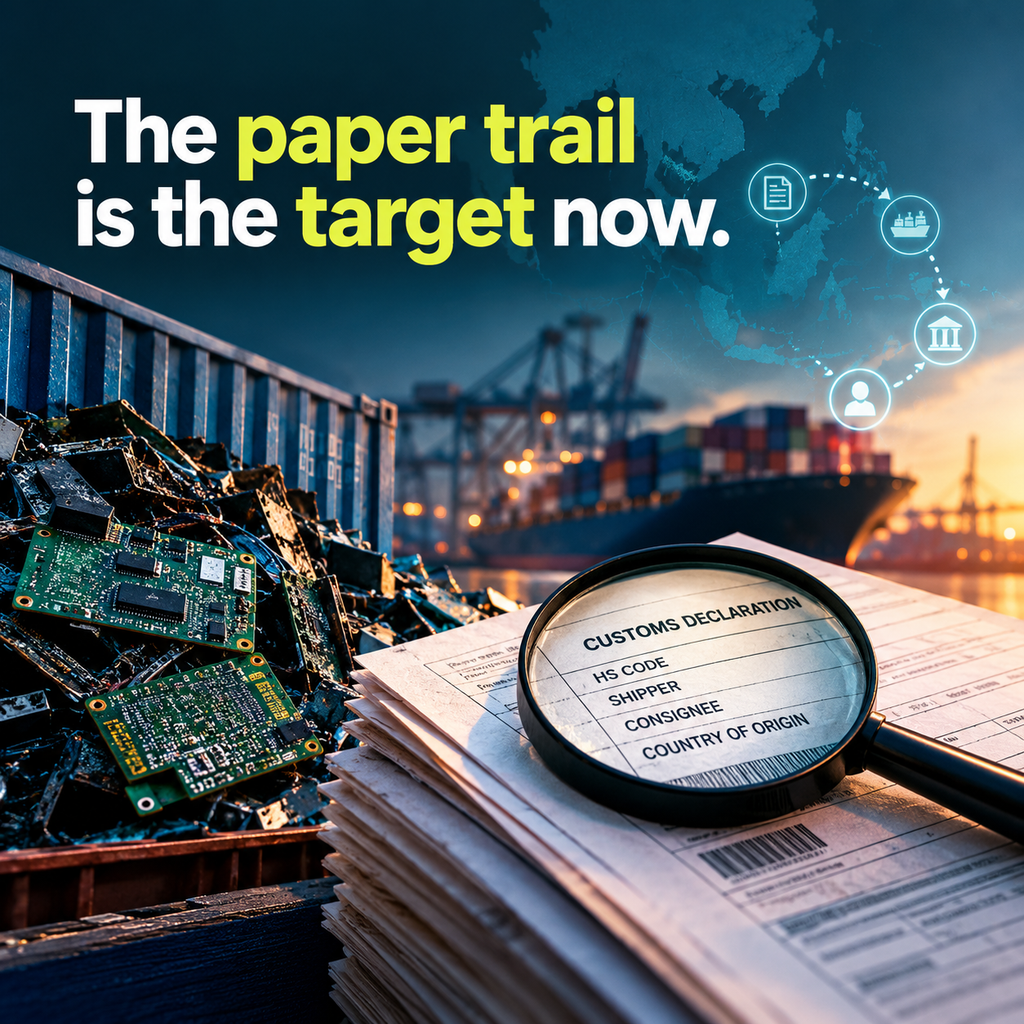
Southeast Asia’s e-waste crackdown has moved from the container to the declaration, the carrier and the money. The exposure runs back up the chain.
Malaysia has re-exported 436 containers of e-waste this year. Another 578 start leaving this month. When I wrote about the export doors closing, the story was the law. Since Malaysia’s ban took effect in April, the story has been enforcement, and it isn’t aimed at the box any more. It’s aimed at the paperwork, the carriers and the money behind them.
That matters to anyone who moves retired IT hardware in this region, including companies that have never shipped a container themselves.
What the last six months look like
Malaysia’s absolute ban on e-waste imports took effect on 1 April, written into law as a customs prohibition on specified electronic waste. Enforcement started before that. A joint operation at Port Klang led by the Malaysian Border Control and Protection Agency (AKPS) began on 27 February and had detected 763 containers by 22 April. By early July the task force had inspected 685 and moved the first 143, about 3,060 tonnes, off the port for investigation. By late September AKPS reported 436 containers re-exported, with 578 more scheduled from October.
Thailand is moving the same way. In March, customs at Laem Chabang seized 18 containers of e-waste declared as scrap iron, metal scrap and aluminium scrap. On 25 August the Department of Special Investigation (DSI) asked for a freeze on another 50 containers. When ten were opened the next day, four matched their declarations; six held mixed circuit boards or material suspected to be hazardous waste. Officials also reported no record of 14 of the 50 having entered the country. Across all environmental offences, not only e-waste, Thai customs reported 187 cases between October 2025 and August 2026, covering about 9.7 million kilograms of seized goods.
| Malaysia | Thailand | |
| Legal basis | Customs prohibition on specified e-waste from 1 April 2026 (Customs (Prohibition of Imports) (Amendment) (No. 3) Order 2026) | Customs Act 2017, s.244: up to 10 years, a fine up to 500,000 baht, or both; goods can be forfeited |
| Scale, 2026 | 763 containers detected by 22 April; 143 moved off port by July; 436 re-exported by late September; 578 more from October | 18 containers seized in March; 50 frozen in August; 187 environmental customs cases of all kinds, Oct 2025 to Aug 2026 |
| Reaching past the box | Anti-money laundering investigations (131 containers by April); 50 companies proposed for customs blacklisting; licence suspensions proposed for shipping lines that failed to remove flagged containers; anti-corruption commission involved | DSI tracking financial links behind the shipments; multi-agency inspections chaired by the environment minister |
Table 1. Basis: Malaysian Border Control and Protection Agency statements via The Star, New Straits Times and Malay Mail (April to September 2026); Thai Customs, DSI and PRD statements via The Nation and The Pattaya News (March to September 2026).
From the container to the chain
Read the bottom row of the table again. Anti-money laundering investigations, proposed customs blacklists for importers, proposed licence suspensions for shipping lines that don’t clear flagged boxes, an investigation unit following the money. Every one of those tools reaches somebody who most likely never touched the material.
The mechanism is the declaration. A container of circuit boards declared as scrap iron is a customs offence before it is an environmental one, and customs offences come with documents: who declared it, who paid for it, who carried it, who sold it. In my experience, whoever enters the HS code is often working from paperwork rather than from the goods. That gap between what the declaration says and what’s in the box used to be a paperwork detail. Once someone opens the box, it’s evidence.
The gap between what the declaration says and what’s in the box used to be a paperwork detail. Once someone opens the box, it’s evidence.
The Laem Chabang numbers show why that matters. Four of the ten containers opened in August matched their paperwork. The other six didn’t, and officials then pulled three more containers from the same importer. Once one declaration fails, the other shipments on that paper trail get opened too.
Why it reaches the generator
So far the pressure lands on importers, carriers and the networks behind them. None of the reports I’ve read name the company whose equipment ended up in a seized container. Three things are worth keeping apart here. Investigators being able to trace a chain is one. A company’s name turning up in that chain is another. Being found legally responsible is a third, and it needs far more evidence than the first two.
Under the Basel Convention, what happens to an illegal shipment depends on who caused it: the exporter or generator takes it back, or the importing state handles disposal, or the two states work it out. Either way, the records travel with the case. Export documents name the parties to the shipment, and contracts, invoices and payments can show the trades before that. For a corporate generator that sold retired hardware to a broker by the lot, the chain goes dark after the first handover, while an investigator now has a route to follow. With IT equipment there’s a second risk. An asset tag in a seized container can become a reputational problem long before anyone asks a legal question.
This lands in a region where the generator is often a multinational with a Japanese, Korean or European parent, and where a disposal vendor three steps down the chain is invisible to the head office that signed the sustainability report.
What it means for anyone moving IT assets here
Three things follow. First, in-region processing gets more valuable, not less, which is the thread running from the export doors piece through the Johor deep-dive. Material that never crosses a border never has to be declared at one, although domestic waste rules still apply.
Second, documentation becomes part of the product. A certificate that says material left your site isn’t enough any more. It needs to say where the material went next, what it was declared as if it crossed a border, and whether the weight that arrived matched the weight that left.
Third, the highest offer isn’t the safest one. A price per kilogram tells you what a buyer will pay, not where the material goes, how it’s processed, or whether that chain would survive an investigation. The tools to test that chain are now in use in both countries.
If your retired hardware leaves through a broker in this region: could you show where it ended up, and what it was declared as on the way?
Enforcement figures are from official statements as reported. Where the pressure goes next is the author’s inference; no report cited names a generator, and tracing a chain is not the same as establishing responsibility.
Sources
The Star, “763 containers of e-waste intercepted at Port Klang since Feb 27”, 22 April 2026.
Lowyat.NET, “Malaysia fully bans e-waste imports, ending all exemptions”, 2026 (Customs Amendment No. 3 Order 2026, effective 1 April).
New Straits Times, “143 e-waste containers removed in Port Klang operation”, 6 July 2026.
Malay Mail / Free Malaysia Today / Bernama, AKPS: 436 e-waste containers re-exported, 578 more from October, 27 September 2026.
The Nation, “18 falsely declared e-waste containers seized at Laem Chabang”, March 2026.
The Pattaya News, “Environment Minister leads multi-agency probe of suspect e-waste containers at Laem Chabang”, 14 September 2026.
Thailand PRD, UNODC recognition of Laem Chabang enforcement, 19 March 2026.
Thailand Customs Act B.E. 2560 (2017), section 244 (Thai Customs Department).
Basel Convention, Article 9: illegal traffic.
Bernama, AKPS phase update, 14 August 2026.