
By Viktor Yoshimura – 8th of October 2026
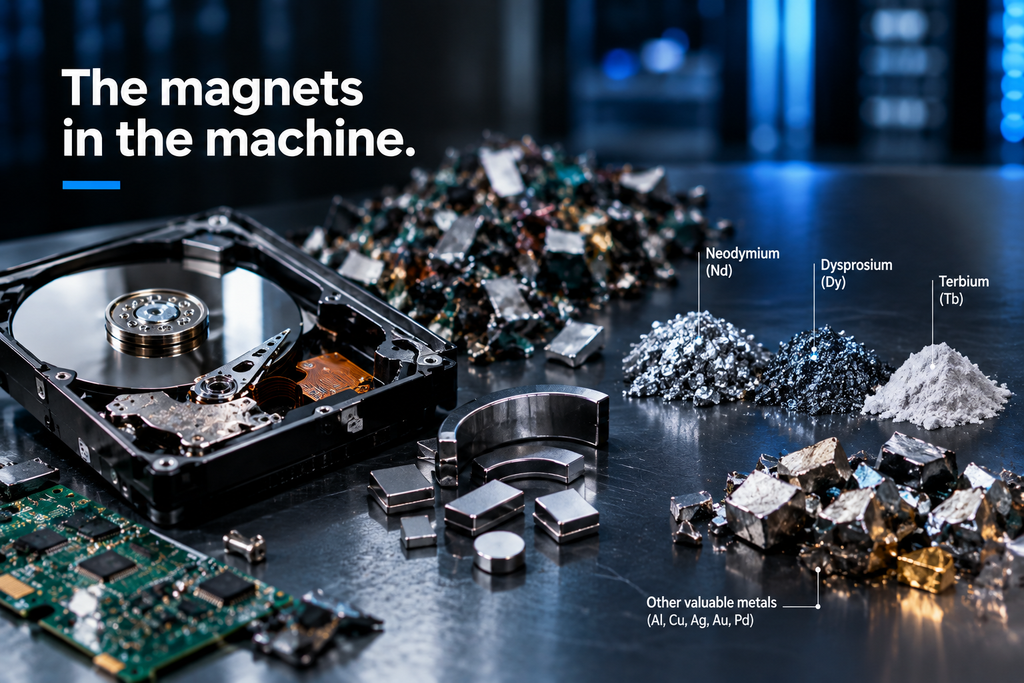
Recovering rare earths from hard drives mostly doesn’t pay. Data-centre drives through ITAD are the one stream where it might, because someone else has already paid for the expensive steps.
Rare-earth recycling usually breaks before the chemistry starts: getting the magnet out of the device costs more than the magnet is worth. For hard drives, that has been the standard reason to write the stream off.
However, there is one stream where that step has already been paid for. Data-centre drives coming through ITAD are collected under chain of custody, concentrated at a handful of facilities, and shredded for data security before anyone asks what’s inside them. Recovery chemistry now works on that shred. The economics after the shredder are still unproven, but this is one of the few end-of-life sources where they have a real chance, and Japan is where that matters most.
Where rare-earth recycling usually breaks
David Daoud set out the problem clearly in a recent Resource Recycling analysis: rare-earth recycling economics are decided source by source, and the central obstacle is usually collection and disassembly rather than recovery chemistry. Removing a small magnet from a hard drive can take manual labour worth considerably more than the material recovered.
That matches the wider picture. The IEA notes that most rare earth recycled today comes from manufacturing scrap (concentrated, consistent, and available before products reach consumers), while collection rates for end-of-life permanent magnets sit below 15 percent. The magnets that get recovered are mostly the ones that never left the factory.
For consumer electronics that is decisive. The rare-earth content is small, embedded and scattered across millions of homes and offices, and no chemistry fixes a collection problem.
What ITAD has already paid for
Data-centre drives are a different stream, and the difference is structural rather than technical.
| Consumer drives | Data-centre drives through ITAD | |
|---|---|---|
| Collection | Dispersed; depends on take-back and household disposal | Contracted, under chain of custody from the rack |
| Concentration | Millions of locations | A small number of processing facilities |
| Disassembly | Manual magnet extraction, rarely worth the labour | Already shredded; the client paid for it as data destruction |
| Volume trend | Declining as SSDs displace hard drives | 2026 nearline capacity sold out on AI demand |
Table 1. Basis: IEA (2024); Western Digital and Seagate statements, February 2026; author’s analysis.
The third row is the point. In ITAD, reducing the device to something a recovery process can accept is a data-security service the client has already bought, so it never appears as a recycling cost. The shredding happens regardless of what anyone does with the output. The client pays to destroy data; the feedstock is a by-product of that decision.
What changed is that the output is now usable. A pilot run by Western Digital, Microsoft, Critical Materials Recycling and PedalPoint Recycling recovered more than 90 percent of the rare earths from shredded drive feedstock, as oxide at better than 99.5 percent purity, with no hand-harvesting of magnets. It processed about 21 tonnes over 18 months, so it proves the chemistry rather than the economics at scale. It removes the technical reason the drive stream was written off. The economic question stays open: separation, transport, chemical processing and yield all still have to be paid for after the shredder.
The arithmetic is in the mass balance.
| Output fraction | kg per tonne of feedstock |
|---|---|
| Aluminium | 481.5 |
| Ferrous | 299.8 |
| Copper and precious metals (Cu, Ag, Au, Pd) | 5.0 |
| Rare-earth oxide | 2.4 |
| Other / not separately reported | ~211 |
Table 2. Western Digital et al., Advanced Recovery and Rare Earth Capture at Scale, June 2025. Feedstock: shredded end-of-life HDDs, SSDs and caddies.
Rare-earth oxide is a quarter of one percent of the input. The feedstock is also mixed: the magnets sit in the hard drives, while SSDs and caddies add aluminium and board metals, so the share of hard drives in the load is another variable in the economics. On this mass balance, it reads as a material-bundle business carried by the aluminium and board metals, with rare earth as the strategically important fraction. Anyone pitching drive recycling as a rare-earth play is overselling it.
Why Japan, and why now
Two things make this a Japanese question before it is anyone else’s.
The first is supply. On China’s own customs data, its export-controlled rare earths, dysprosium and terbium among them, have gone to Japan at zero for three consecutive months through August, a freeze tied to the diplomatic dispute that began in November 2025. Finished magnets keep moving: about 212 tonnes in August, down 17 percent on a year earlier. That is a supply disconnect. The finished product keeps arriving; the controlled inputs to make your own have stopped, at least from China.
The second is capability. Japan keeps one of the few significant rare-earth magnet industries outside China (Shin-Etsu Chemical, Proterial and TDK), so the country being squeezed is also one that can use recovered material. The loop is already forming in adjacent products: in April, Daikin, Shin-Etsu and Tokyo Eco Recycle, with Hitachi’s support, announced a programme to recover magnets from commercial air-conditioner compressors, running at full scale from 2027.
And the drive stream is growing. Consumer hard drives are in long decline, but Western Digital and Seagate both said in February that their 2026 nearline capacity was sold out or fully allocated on hyperscaler AI demand. On a typical four to five year service life, those drives start reaching ITAD around 2030 and 2031, on the same clock as the regional decommissioning wave I set out in the pipeline piece. The feedstock this depends on is being installed now.
The gap is the workflow
In the Japanese ITAD work I’ve seen, destruction is where the job is considered done, for good reasons: enterprise and government audits test the manifest chain, and past data-leak cases hardened the standard. None of that needs to change. Recovery sits after destruction rather than against it: the drive is shredded for security either way. I argued recently that destruction belongs on site, as a colocation service. Wherever it happens, the shred leaves the building the same way.
What I haven’t seen is the step after. The certificate of destruction is where everyone’s attention stops. The data is gone, the paperwork closes, and the shredded fraction leaves on a truck to a metals buyer, where the magnet goes into the ferrous stream and the rare earth is lost. The chain is paid to recover bulk metal. Nobody is paid to find and keep the rare-earth fraction.
The certificate of destruction is where everyone’s attention stops.
Closing that gap is mostly contractual and logistical rather than technical: segregating drive shred from mixed metal, routing it to a recoverer rather than a smelter, and documenting it well enough that the client’s auditors are as comfortable with the second step as the first. That is operator work, and I haven’t yet seen anyone in Japan build it as a standard workflow.
If you run or buy drive destruction in Japan: do you know what happens to the shredded fraction after the certificate is issued?
The argument that data destruction has already paid for disassembly is the author’s analysis. The pilot demonstrates recovery chemistry on shredded feedstock at around 21 tonnes, not commercial economics at scale.
Sources
David Daoud, “Why only some rare-earth sources are economically viable,” Resource Recycling, 24 September 2026.
IEA, Recycling of Critical Minerals (2024): end-of-life magnet collection below 15%; manufacturing scrap as primary feedstock.
Western Digital, Microsoft, Critical Materials Recycling and PedalPoint Recycling, Advanced Recovery and Rare Earth Capture at Scale, white paper, June 2025.
Silverado Policy Accelerator, Rare Earth Trade Report, September 2026: China customs data, controlled rare earths to Japan at zero, June to August 2026.
South China Morning Post, 20 September 2026: China customs data, rare-earth magnet exports to Japan, August 2026.
Crux Investor, 20 July 2026: China customs data, zero dysprosium and terbium to Japan, June 2026.
Fastmarkets, 14 April 2026: Daikin, Shin-Etsu, Tokyo Eco Recycle and Hitachi compressor magnet recovery programme.
The Register, 20 February 2026: Western Digital and Seagate 2026 nearline capacity sold out.